Wednesday, February 27, 2008

Never Gets Old


This is the view from my balcony.

Saturday, February 23, 2008

Identity Crisis

When one is in Cairo, one must take advantage of some of the excellent services and products which are way cheaper than you could ever get them in the States. Massages run for about 20 dollars, eyebrow waxing is less than 5 dollars, and you can get fine quality tailored suits for under 100 dollars. For all the recent college grads who have run into the issue of buying their first business suit, sometimes it can be a little nauseating to realize that a nice suit can run anywhere from $300 to $800, and those aren't even tailored to fit. So with a closet full of linen skirts and baggy sweaters and a calender full of conferences in Dubai and interviews with politicians, I thought it was high time that I treated myself to of the benefits of being Cairo.

One of my friends, Dave, had already gone through the process and had some snazzy suits to show for it. He took me and some other curious Americans to the textile district of Cairo where we tucked into his favorite cloth merchant. We helped him pick out a nice shade of grey for his new suit, chatting up the shop owner. Dave had his suits made elsewhere by an independent tailor, but he wasn't sure if his tailor did women's suits, or if it was improper for a woman to be fitted by a man. So I seized the opportunity and asked the cloth merchant if he knew of a place where women could get suits, rather, of a place with women tailors. The cloth merchant nodded immediately saying that it is best for women to go to women tailors, and men to go to men, but that I was in luck. There was a woman tailor who worked with his store. Her name was Um Ibrahim, which literally means Mother of Ibrahim. However, the cloth merchant kept insisting on using the male pronoun (hoa) when talking about Um Ibrahim. I thought maybe this was a new colloquialism that I didn't know, and I continued to use the female pronoun (hea) when talking about my future tailor. I was a little confused, but brushed it off after all the comments of "women should tailor women" and because her name was Mother of Ibrahim. (Fun Fact, this title is extremely common in the Arab world. When women become mothers or men become fathers, they will often take on the name of their first born son. So if a family's first born son is named Mahmoud, the father may take on the name Abu Mahmoud, and the mother Um Mahmoud.) Continuing with the story, the cloth merchant helped me pick out what cloth I wanted, black terry wool, and then we planned that next Friday Um Ibrahim would take my measurements.

Come Friday, I return to the shop and the cloth merchant greets me and asks me to wait 10 minutes for Um Ibrahim to come. I sit, going through my calendar, waiting for my matriarch to arrive and take my measurements. I wonder what she will be like? Will she be old or young? Will she be covered or uncovered? Will she be overly friendly or cold? Lost in my thoughts, I hear the cloth merchant say "Um Ibrahim has arrived!" and I look up, and she is definitely a dude. Of all the questions I had pondered over, "will she be a he" was not one of them. For a split second, I thought about saying something. Not so much that I personally minded being measured by a man, but more so worried about what implications it might hold if somehow I was breaking a taboo that Egyptian women never broke. But I looked at Um Ibrahim. He was definitely a man, but he was an old man, grey, withered and most importantly, professional. I smiled, stood up, and went to the corner with him. He was very quick, and extremely polite and cautious not to touch me more than he had to. His hands were fast yet precise, and he didn't seem to think that this was out of the ordinary or that I was any more exciting than a plastic mannequin. He showed me some models of women's suits, and I picked out the one that I wanted. He smiled and said it would be ready in a week. I left the store excited for my new suit, but nonetheless slightly puzzled by the whole experience. Language barriers never cease to keep things interesting. I'm not sure if I will ever know what happened, but I do know this. If I ever have to make a trip to the gynecologist while I am here, you can be sure that I will require 3 forms of photo id to make sure that my doctor is in fact a woman.

Saturday, February 16, 2008

Who needs a road side bomb?

Who needs a road side bomb when you can buy a hand gun? Who needs a hand grenade when you can just use your 2nd amendment-cited-God-endorsed-right to own an object whose sole purpose is to take a human life? Don't worry about your right to not die in a bloody shoot out in a lecture hall, we must provide our other citizens with the right to buy a hand gun from their local store. If not, they might turn to buying their weapons on the black market, and then it would be unregulated, and suddenly you might have all sorts of maniacs buying guns and using them to open fire on university campuses and city halls, and you couldn't even imagine what sort of inhumanity that would be! But thank goodness this isn't the case, the massacre at Virginia Tech didn't happen, the murders at NIU didn't actually occur, and classes went as normal at Louisiana Technical College.

Supposedly, I am the one surrounded by violence in the Middle East. Supposedly, I should be the one scared to walk outside my front door for fear of a war breaking out or out of panic that a revolutionary guard might kidnap me and videotape me in tears. Supposedly, I should be the one in danger of losing my life to senseless violence, not American students on a University campus. It should be me, not the slain students of Virginia Tech. It should be me, not those recently murdered at Northern Illinois University. Instead, I find the news from American news splattered with stories that make me frightened to return home. Here's a head line for you, "AMERICAN GIRL AFRAID TO RETURN HOME FOR FEAR OF LIFE". I don't even want to compare the murder rates of Cairo and DC, that actually might seal the deal for me and make me cancel my plane ticket.

Gun violence by people with no criminal record, no history of erratic behavior, no reason to be turned down by the current gun laws is becoming an epidemic. How many more people need to lose their lives in a "safe" place before we do something about it? How many people must be sacrificed for the nonsensical logic of legally buying guns to protect yourself from other citizens who have legally bought guns? America is supposedly fighting a war against terror, but from over here, it looks like the terrorist are not only winning, but we are happily and legally supplying them with their weapons of choice.

Sunday, February 10, 2008

Oh Happy Day!

"Mabrook! Alf Mabrook!" Tonight I broke my rule of smiling and talking to strange men. I couldn't help it, tonight they deserved it. Egypt just won the African Cup of Nations, and I haven't seen so many smiles since freshman year when we beat Ohio State in the big house. The streets were packed, swarming with happy Egyptians, proud of their country, proud of the team, and I hope, proud of themselves too. With faces painted, banners waving, firecrackers were set, drums were pounded, and there was a palpable sense of unity out there in the streets. It felt like Germany had just surrendered, and I was expecting a sailor to dip me and steal a kiss. Luckily, no such thing happened, but it felt like a war had been won, and we were on the winning side. So I happily smiled, and passed out my "congratulations, a thousand congratulations!" to my hosts. Egyptians often feel the weight of the world in their daily life; unemployment, censorship, corruption, pollution and repression can take their toll. So it was nice to see, for one night, thousands of Egyptians in a euphoria. It may only last one night, or a week, but at least we can be sure that for now, Egypt is having one hell of a time.

Monday, January 28, 2008

Comprehending the Veil

“So…what’s up with that veil thing?”


This question comes up a lot for me, and I don’t even wear a veil. I can’t even imagine how often it must come up for Muslim women who wear one when they are talking with non-Muslims who are befuddled by the piece of cloth. In general, the Islamic veil is known by a simple and encompassing term: hijab. Hijab comes from the Arabic word meaning to cover, screen, or shelter. The word for eyebrow, hawajib, even comes from the same root as they serve to shelter the eye. Forms of Hijab come in very different shapes and sizes, colors and fashions and vary between countries, classes, age groups, and personal preference. As a tip for anyone who is ever unsure of what to call the Islamic headscarf, hijab is generally the go-to-word. Anything more specific leaves room for mistakes, as sometimes it is hard to keep a niqab from a burqah from a chic veil. If you are curious, the niqab is when a woman’s face is covered except for her eyes (often a detachable square piece of cloth over the nose which is secured on the veil around the face) And, most importantly, a burqah is NOT any old veil. Burqahs are the fully covering head piece which were made famous by Afghani women (largely not by their choice) in which their eyes and face are covered by a mesh-like fabric. Again, if you are already feeling a bit shaky about the terms, remember that you can’t go wrong with using "veil" or “hijab”.
So why the hijab?

An easy answer that many Muslims might give is that they believe that God commanded women to cover all but their face and hands. But this begs the question, why? And of course those Muslims have also asked this question, and while there are different interpretations, a common one seems to be that the hijab promotes respect between men and women. This is because within Islamic tradition, hijab is not just the veil or whatever head covering a woman wears. It also encompasses the idea of modesty, of respect; the idea that a woman should be treated as a person, and not as a sex object. Men of society should interact with women as peers, intellectual equals, and not be distracted by immodest, inappropriate attire. As interpreted by many Muslims, God in his ultimate wisdom, has commanded women to take it upon themselves to prevent such a scenario, and cover themselves. But men aren’t off the hook, as it has also been commanded that they avert their eyes and treat women with the respect that they deserve. Before you get thrown, remember that many different cultures and religions have different definitions of what is appropriate and what is not. In parts of the world, there is nothing wrong with a woman bearing her breasts. In Kansas, there is certainly something inappropriate about it. And likewise, in Islam, many have interpreted hair to be inappropriate for public. If you find yourself unable to make this leap of logic, just remember how puzzled a Polynesian might be at the seemingly oppressive bra and shirt that American women wear, gasp, and by choice!

Now, even understanding the different standards of modesty,you still might ask, doesn’t this somehow put the burden on women? Sure, God commanded men to also avert their eyes, but if God also commands women to cover themselves, doesn’t that some how imply that ultimately men can’t help themselves? Why is it that women should have to take the extra step to cover themselves just because guys can’t somehow control their sexual urges? It’s not my fault my boss is a caveman and can’t take me seriously, I shouldn’t have to compensate for his weakness!

I used to feel this way. I was able to understand the reasoning behind the hijab (I think every girl can when she walks down the street and is made to feel degraded and humiliated by the cat-calls of a disrespectful man) but I still felt frustrated that the onus of the responsibility seemed to fall on the woman. But then I remembered that this is not only true of Islamic tradition, but of American society as well. One such example, a classic, which shows the unequal expectations for controlling sex drives takes place at a college frat party. No girl, in her right mind, would ever let her drunken girlfriend be alone in a room full of drunk frat guys for the night. Reverse the roles, and see how comfortable a guy would feel in a room of girls. Of course its not fair, but its not about fairness. It’s about being smart. Girls have these rules about watching out for each other, and for themselves, because no matter how you would hope guys to act in a perfect world, you don’t risk rape or sexual assault for the quixotic dream of gender equality.

So even in America, where we like to claim gender equality, you can find examples of girls taking on extra responsibilities to preempt ugly scenarios. Its not that you are some how condoning the weakness of guys; by avoiding the roomful of 30 drunken frat boys you aren’t somehow saying that sexual assault is okay. You are just taken a precaution in the same way that when a Muslim woman dons a hijab to avoid being treated like a piece of meat by her boss she isn’t excusing that disrespectful behavior.

Is this the only reason that women wear the hijab?

Of course not. There are thousands of reasons and explanations that women (and social scientists) give for the veil.* For some they are simply trying to be good Muslims in their daily life, for others they might see it as a political symbol of resistance or affiliation with Islamic reform movements who oppose the corruption and dictatorship of various secular regimes. Some might also see the veil as a rejection of Western imperialism, of American hegemony and globalization which has stripped them of their own culture. This is summed up in a quote by Adil Hussein, a late leader of the Egyptian Labor Party.


"Why can't we not only have a dress that is modest, but also have one which we have created in the region, like the Indian sari? Why can't we have our own dress which expresses decency, a requirement of Islam, as well as the special beauty that would be a mark of our society which has excelled in the arts and civilization?"


Of course there are still other explanations that believe that the use of the veil has a functional explanation such as lowering cost of attire (and hair salons) or shortens the time and energy a woman uses to beautify herself. And finally, never underestimate the power of social pressure, family pressure, and good ol peer pressure in determining what women wear. Once enough of your Muslim peers begin to don the veil, you might feel like you stick out a bit if you don't. Or maybe you've heard that the young men are only interested in marrying a veiled woman. But, I think it is important to remember, that Muslim women tend to be vehemently proud of the fact that it was a personal choice to wear the veil. Often they find it frustrating that women in the West have the freedom to wear skimpy clothes, but judge other women for wearing more.

Most veiled women just wish that Westerners would just hurry up and get over the whole veil thing. Read up on it, learn about it, and then see past it. Lets leave it up to 4th graders to judge people for what they wear or don't wear.


*Inspiration for this passage came from Saba Mahmood's article "Feminist Theory, Embodiment and the Docile Agent: Some Relections on the Egyptian Islamic Revival."2001. Cultural Anthropology, 6(2):202-236.

Friday, January 25, 2008

Your friendly neighborhood Camel Mart?


My trip to the camel market had been quite overdue. Fresh out of sugar, salt, and camel, I had to head down to the local store. Hopefully you don't actually think that I make a habit of munching on camel, but the concept is actually not as far fetched as you might think. Camels are largely sold here in Egypt not to be beast of burden as much as to be ingredients in stew, but don't tell these guys to my left. They were two of hundreds of camels being displayed, bought and sold at the Cairo Camel Market. Located quite a bit out of the city and accessible through a series of mini buses, the market is a tourist destination only for the strong willed and definitely not PETA members. As much as the camels look like they are enjoying themselves with their constant smiles (except when they are snarling and reproducing alien noises which sound like a mix between a roar and a burp)they are certainly not pets, and so aren't exactly cuddled. One leg is tied up in order to keep their movement a bit limited, and they are often beaten strongly with a large wooden cane by the various camel vendors. While I couldn't help but wince at the seemingly harsh whacks, I definitely appreciated the limited movement of our one humped friends. Camels are huge. Can't emphasize it enough. With the average height of their head at about 7.5 feet and weighing about 600 pounds, these babies aren't the daintiest of mother natures children. As much as it pained me to see them uncomfortable hobbling around on three legs, when one got loose and was running around the lot I couldn't help but be thankful that there weren't 600 loose and using us as foot stools.


While there were a few moments of panic upon being stuck between two burping and disgruntled dromedaries, overall, I was charmed by everyone of them. What can I say, I am a sucker for the even-toed ungulates with their thick eyelashes and small hairy ears. I even like their ridiculously cantankerous vocals. But most of all, I love their smiles. There is a saying in the region that the camel is smiling because he knows the 100th name for God. In Islamic tradition, there are 99 known names for God, so of course if you know that desired 100th, you'd probably be smiling too.


It's always a little strange being a tourist at a place where people are just doing their job, you don't want to be that person who treats someone's livelihood like a game. But I think that the buyers and sellers got a kick out of the fact that we tourists were enjoying ourselves so far away from the pyramids, and marveling at the beasts which despite being undoubtedly mundane for them, hopefully still retain some charm for the seasoned salesmen.

Friday, January 11, 2008

Lewis of Arabia-Part II


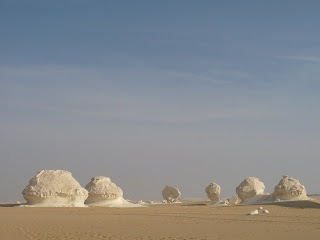
It was pitch black outside when we pitched our tent. And by we, I mean Ali and Karem. And by tent, I mean a two sided roofless structure, whose “walls” are supported by the two trucks. Our two Bedouin professionals had set all this up in less than 15 minutes, so that by the time we were finished gazing flabbergasted at the star-filled sky, we had a place to sit around the crackling fire. With the sun set and our car troubles behind us, we had a magical evening. Without the lights of a city in sight, the stars took centerstage and lit up the surreal desert scenery. The White Desert is famous for its moon-like surface, giant chalk structures, each a unique shape, tower of the landscape. Like children staring at clouds, we took to giving names to these sand-eroded beasts. “Oh! That one looks like Lenin with an elf cap!” Frances chimed, while Markell contemplated the ice cream sundae, obviously topped with two cherries.

As our tour guides began to prepare dinner, us clueless tourists took to getting to know each other. The German couple remained largely quiet, more into each other than into the burgeoning discussion on culture shock. Jennifer, of Stewart and Jennifer the Canadian couple, was extremely curious about Islam and Egypt, and seeing as I spoke Arabic and had been living in the country for a while, I seemed to be an oasis of answers. I admired her curiosity and her respect for cultural differences, but I couldn’t help but be slightly put off by her racism. Its not what you think, she wasn’t racist towards Egyptians or even Muslims, but Americans. After we had been talking for a while, and it was clear that my sisters and I were open minded, accepting, educated, and overall good Americans, Jennifer excitedly told us, “Wow! This is so great to meet you guys! I gotta say that before this trip, we thought that all Americans were ignorant bigots, but you guys aren’t like that at all!” thanks? While I appreciated that we had changed her stereotypes, isn’t that a bit like a bigoted white American telling an African American, “wow! Before I met you I thought all you guys were idiots!” or maybe like Huckabee telling a Mexican American “wow! Before I met you I thought all you guys were lazy illegal immigrants! And how did you get over my fence?”

Despite these thoughts, I strove to be a good Fulbright cultural ambassador-even to Canadians-so I smiled, and said that we were glad to have been proof of the inaccuracies of stereotypes. Another highlight of our enlightening conversation was when Jennifer asked me about all the lingerie stores she had seen in Cairo. “But how can these veiled women ever where that skimpy outfit! Are they walking around with nothing underneath but that!?!?!?” I calmly explained to the amazed Canadian, that while Muslim women may choose to be modest in the street, or even choose to be fully covered, when she is with her husband, no holds bar. I believe this concept may have blown her mind, as perhaps before she thought that a veiled woman was veiled even with her husband in the bedroom? This conversation then moved somehow to pornography, where I explained that of course there is pornography in the region, maybe no one talks about it but there is absolutely Arab pornography production. Afterall, where this a demand there will be a supply. “OH MY GOD!” more mind blowing “It’s a part of the culture here!?!??!” what, sex? Actually, contrary to popular belief, they do have sex in the Muslim Arab world. Even more shocking is that teenage boys here actually have, gasp, the same hormones as Christian Americans! Of course pornography is frowned upon and its not as publicly accepted as in Canada and the US, but its still here. It always cracks me up what encourages cultural understanding.


By the time we had covered American hillbillies, Egyptian negligee and the Lebanese porn industry, dinner was ready. Fire cooked chicken, hearty potatoes in a tomato-onion sauce, and delicious rice. With plenty of food for seconds, we ate happily until our bellies were full and our calorie intake sufficient to last the cold night. If foreigners are surprised by Egyptian lingerie, they seem to be even more surprised by the fact that desert equals freezing at night. The same sand which was too hot to touch during the day becomes equally unwelcoming to a barefoot at night, unless you like stepping on ice. We layered on our clothes, wrapped ourselves in scarves, and huddled around the fire. I chatted with Ali and Karem about the Bedouin dialect of Arabic while we all sipped delicious mint tea. After the third round of tea, with the moon still not risen, we turned in for bed. My sisters and I claimed three mattresses, and constructed a giant bed for us out of the ample sleeping bags and blankets supplied by our guides. Markell suggested that we spread out all the sleeping bags on top of us, but Frances and I thought it would be better for us each to have a bag and then just put the 3 giant blankets over us. While we lay in bed, staring at the stars, I was even a bit hot underneath the 4 layers. I snuggled up next to my sisters, and fell asleep underneath more stars than I knew existed.

I woke up shivering with my foot in my mouth. Markell had been right, never underestimate the power of body heat and the wisdom of big sisters. I tossed around a bit, looking for my pillow which never existed, and quickly drifted off to sleep. I woke up numerous times that night, opening my eyes to a gorgeous moon which lit up the night, although it couldn’t help me find that pillow. I mistakenly grabbed the lump which was near my head, only to realize that it was the Afrikaner’s feet wrapped in a sleepingbag. Each time I woke, I shivered, marveled at the moon, searched for a pillow, and then fell back asleep. It wasn’t the best sleep I have ever gotten, but certainly tops the list for location. The last time I woke up, it was from Markell’s persistent “time to get up Paulina, gotta watch the sunrise” I groggily opened my eyes and huddled closer to Markell. Frances was off taking photos, luckily for her, she doesn’t have as many sexy morning shots as me and Markell. In our frigid state, we encouraged the sun to rise and warm us. “Yallah yallah ya shems!) (go go oh sun!) Markell produced a packet of raisins which I had dissed earlier “I never really enjoy raisins.” The cold helped me change my opinion, and we feasted on the calories of dried grapes. The sun rose, and Frances returned, turning her camera on us. We look like refugee tourists, featured in a back issue of National Georgraphic.


Camp was slowly stirring, and as we ventured off to our own personal toilets behind the chalk structures, Ali and Karem began to set up breakfast. Jennifer, our Canadian friend, was loudly explaining to everyone how freezing last night was and how horrible her sleeping experience had been. Amazingly, it was even colder than camping in Canada pause, in the summer. We smiled and reminded her that it was December, but the point may have been lost.

We feasted on coffee or tea, bread, jam, halwa (sweet sesamee spread) and cheese. Markell and Frances got into a conversation with the Afrikaner couple, regarding race relations and education in South Africa and California. Similar issues, different standpoints. Norman, a self-admitted conservative, also admitted to being grateful for America’s military prowess in the world, explaining that it keeps “them” from power. As much as I wanted to push and ask who is this “them” that we speak of, I kept the conversation light and ended the conversation by saying that as much as I can appreciate the need for a strong military, I think that we need to rethink the strategies and policies which use or abuse that military power. Proving the importance of keeping things friendly, Nelson later approached me and praised our attitude as being “socially aware” and recognized that his perspective on the world was largely due to being a bit long in the tooth. I accepted the olive branch and agreed that both perspectives are important, and need each other to achieve a healthy equilibrium. But seriously, will somebody please tell me who this “them” is? Maybe Guliani knows…


After brushing our teeth and packing up, we explored around camp while we waited for our car to start. The old drill, push, dig, and pull, and eventually the ol jeep started up. We piled in, counting heads to make sure no one was left behind (yikes) and head back towards base. We stop along the way to get out and play, handstands and cartwheels and flying leaps were, of course, in order. On our second stop, we are told to hunt for desert roses. Huh? Looking for any sign of flora we all silently sing along to Sting and remain puzzled until our guides show us a desert rose in his palm. They are small black rocks, resembling the everlasting gobstopper (think Willy Wonka here) We immediately scattered, stooped on our knees, and searched for these beautiful creations. I didn’t do so well, but luckily Karem generously gave me one of his treasures, as I am sure that the thrill of the search has decreased slightly for him. We take our booty back to the jeep, pile in, and head back to camp.


It had been quite the 24 hours and my sisters and I were so pleased with the camping experience, we didn’t think we wanted to taint it by staying another night in the less than merry hostel. We had heard from Stuart and Jennifer that the camping part was definitely the best, so we decided to leave on a high and head back to Cairo a night early. When we arrived back at the hostel, I spoke with each member of our camping party about giving a tip to our fantastic guides.

This was expected, and most everyone in our party was completely aware and willing to give a modest 20 Egyptian pounds per head, which is about 4 US dollars. But when I went looking for Stuart and Jennifer, they were no where to be found. I had been worried that our Canadian couple might be troublesome when it came to the tip. They weren’t happy with the travel company who had arranged their package, but I assumed that they would reasonable not take their discontent out on our excellent guides. If the food is bad, you don’t blame the waiter. I found Stuart who told me to go and find the sugarmama, but when I went to Jennifer, she passed me off to Stuart. Eventually, Stuart sheepishly approached me and told me that they were very frustrated with everything, that they had to run to catch the bus back to Cairo, and that while they knew it wasn’t our guides' fault, they weren’t going to tip. (I’m sorry, you lost me there between the fact that you know its not their fault, but that you still aren’t going to tip them….) I pooled the money we had and talked privately to Karem about how we wished we could have given more, but thank you so much. He was incredibly gracious, making me even angrier that he didn’t the money he should have. You don’t go out to dinner if you don’t have the cash to tip, you don’t travel the world if you are going to rip off those who help you survive in the middle of the desert. Just another universal rule.

Since the bus from Bahriyya had already left, we were sent back to Cairo in a giant taxi/soccer-mom station wagon. In the front were the driver (a big guy) his friend (another big guy) and Tom, our sweet little Minnesota boy. In the middle were the Lewis girls, and in the back were our favorites, Stuart and Jennifer. The 5 hour trip was pretty uneventful, except for the fact that we never really breathed easily as our driver preferred to drive on the wrong side of the road and at night seemed to think that lights were optional. The driver tried his best to get some money out of us, even though we had paid in advance, and in addition to fending off these attempts from the front of the car, I was getting other requests from the back of the car. “Could you ask him to turn down the music?” “Could you have him pull over for a bathroom break?” “Could you ask him where he is dropping us off?” “Could you ask him if he could talk to the travel company.” Could you….” Being able to speak Arabic was becoming less and less attractive as the car ride continued. Cairo didn’t come soon enough, we said our goodbyes, and walked home. After washing the sand off, sharing a few beers and laughs over our adventure, my sisters and I went to bed. But before I went to sleep, I said a prayer. A prayer for the past year, for the new year, for the desert and for Egypt, for my sisters and for my mother, and even a little prayer for Jennifer and Stuart and their anti-tip budget tour around the world.